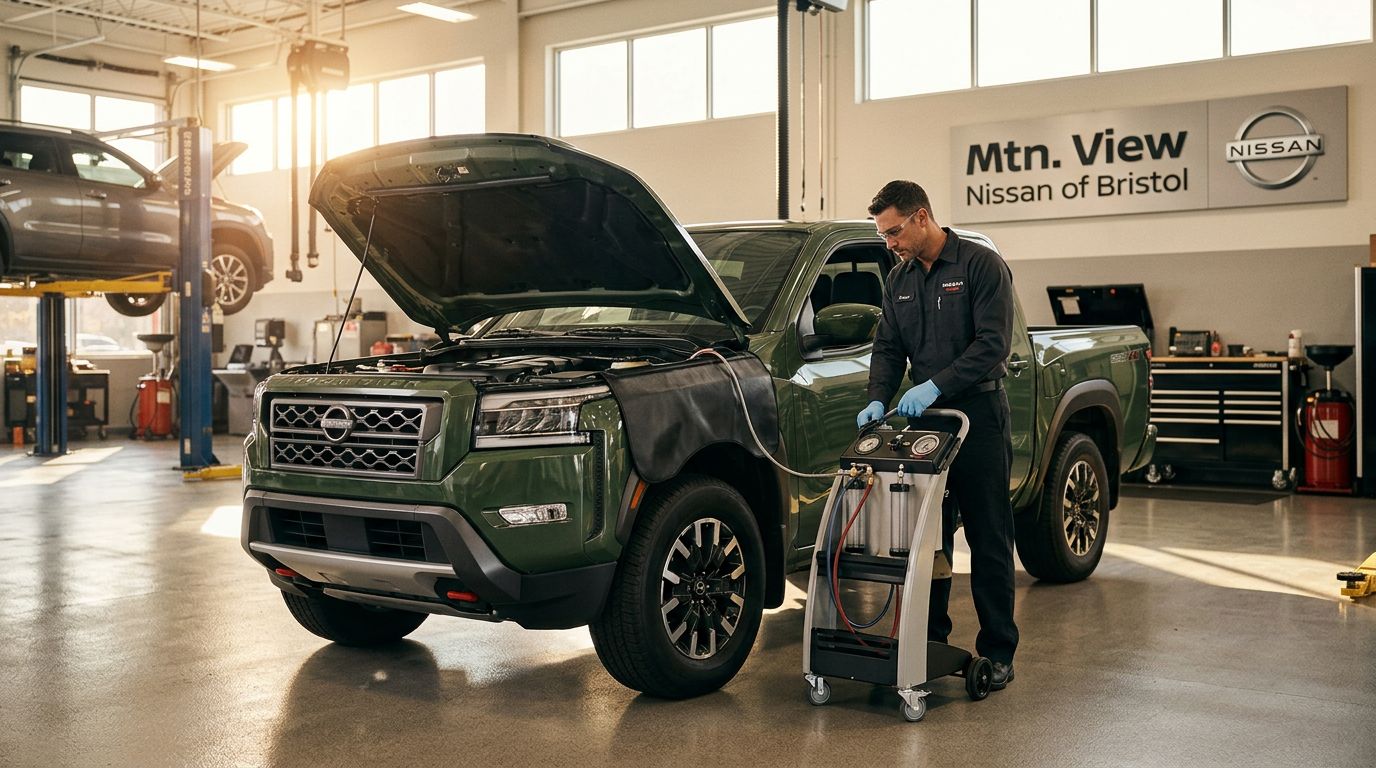
A Nissan requires a complete fluid service every 30,000 miles to 60,000 miles under standard operating conditions, while severe operating environments require fluid inspections every 7,500 miles and earlier replacements. Routine multi-point inspections monitor fluid condition, but complete exchanges for transmission fluid, brake fluid, engine coolant, and driveline lubricants become necessary when chemical additives degrade, moisture accumulates, or vehicle mileage milestones arrive. Operating conditions dictate whether a vehicle follows the standard schedule or the severe-use schedule outlined in the Nissan Owner's Manual and Maintenance Information. Severe conditions include frequent short trips under 5 miles, extensive idling, towing trailers, driving through standing water or deep mud, and traversing mountainous routes in high ambient temperatures. The rolling hills and valleys of the Appalachian Highlands surrounding Bristol place distinct thermal demands on drivetrains, which causes transmission and differential fluids to deteriorate faster than they would during flat highway cruising. Different vehicle systems require complete fluid replacement at staggered intervals based on mechanical workload: Engine Coolant: Long-life factory antifreeze protects aluminum engine blocks against internal corrosion and freezing, requiring its first complete flush at 105,000 miles or 84 months, followed by intervals every 75,000 miles or 60 months. Continuously Variable Transmission Fluid: Modern crossovers like the 2025 Nissan Rogue require CVT fluid inspections every 7,500 miles or 12 months, with a complete fluid replacement recommended at 60,000 miles under severe operating conditions. Brake Fluid: Because conventional brake fluid is hygroscopic and naturally pulls moisture from surrounding humid air, Nissan specifies brake fluid replacement every 24 months or 30,000 miles under standard use, and every 15,000 miles under severe service. Differential and Transfer Case Lubricants: All-wheel-drive and four-wheel-drive models require driveline gear oil inspections every 15,000 miles, with complete drains and refills required every 30,000 miles if the vehicle engages in towing or off-pavement driving. Postponing these services allows contaminated fluids to circulate through sensitive mechanical assemblies. Old fluid loses its thermal transfer capabilities and protective viscosity, leading to friction wear on internal bearings, gears, and hydraulic control valves. Drivers needing guidance on upcoming service intervals can navigate directly to our service center on West State Street or speak with a technician by calling (423) 989-6700. Table of Contents What Transmission Fluid Does a Modern Nissan CVT Require and Are Aftermarket Alternatives Safe? What Brake and Driveline Fluid Specifications Do Nissan Vehicles Require? Can Using Aftermarket Fluids Void a Nissan Powertrain Warranty?" How Much Does a Nissan CVT Drain and Refill or Complete Fluid Package Cost? Nissan Fluid Maintenance: Service Intervals, Fluid Types, and Costs Frequently Asked Questions About Nissan Fluid Care Schedule Certified Nissan Fluid Service in Bristol What Transmission Fluid Does a Modern Nissan CVT Require and Are Aftermarket Alternatives Safe? A modern Nissan Xtronic CVT requires Genuine Nissan CVT Fluid NS-3 for third-generation and newer platforms, while earlier generations specify Nissan NS-2. Multi-vehicle aftermarket fluids should not be used in a Nissan continuously variable transmission because universal formulations do not provide the exact friction coefficients and shear stability demanded by the internal steel drive belt and pulley system. The engineering inside a Nissan continuously variable transmission relies on metal-to-metal traction rather than the geared tooth engagement of a traditional planetary automatic. Two opposing conical pulleys squeeze a heavy-duty steel belt under high hydraulic pressure to alter drive ratios smoothly. The transmission fluid must provide lubrication for bearings while simultaneously generating controlled microscopic traction between the smooth steel belt elements and pulley sheaves. Genuine Nissan CVT Fluid NS-3 features a dedicated friction modifier profile and a precise high-shear viscosity index designed to prevent belt slippage without inducing premature pulley wear. Aftermarket manufacturers market universal CVT fluids claiming broad compatibility across multiple automakers. These universal fluids use compromise additive packages designed to function passably across diverse transmission designs. In a Nissan unit, unapproved fluids introduce severe operational hazards: Belt Slippage: Inadequate static and dynamic friction coefficients cause the drive belt to slip along the pulley faces during acceleration. Pulley Scoring: Slippage creates rapid microscopic scoring across polished pulley surfaces, leading to permanent grooving and internal metal contamination. Excessive Operating Heat: Deviations in fluid thermal conductivity accelerate heat buildup, degrading internal rubber seals and causing hydraulic pressure drop. Transmission Shudder: Unbalanced friction characteristics trigger distinct low-speed shuddering, erratic ratio shifts, and surging under moderate throttle. Catastrophic Failure: Continued operation with degraded or incorrect fluid causes internal belt breakage, requiring a full transmission assembly replacement. Genuine OEM fluids maintain strict chemical composition standards throughout their service life. For vehicle owners performing maintenance, authentic factory-formulated fluids can be sourced through our parts department to ensure exact factory compliance. What Brake and Driveline Fluid Specifications Do Nissan Vehicles Require? Nissan specifies Genuine Nissan Super Heavy Duty Brake Fluid DOT 3 or an equivalent DOT 4 fluid for hydraulic brake systems, alongside platform-specific hypoid gear oils for all-wheel-drive and four-wheel-drive drivelines. Meeting these factory fluid standards ensures anti-lock braking systems react within millisecond tolerances and differential gears remain protected under high torque loads. Hydraulic brake fluid operates under high temperatures generated at the brake calipers during deceleration. In humid Appalachian mountain regions, elevated ambient moisture poses a continuous threat to brake systems. Glycol-based brake fluid absorbs ambient humidity through microscopic pores in flexible rubber brake hoses and master cylinder reservoir breathers. When brake fluid moisture content exceeds 3 percent, its boiling point drops significantly, which can lead to vapor lock and sudden pedal fade during sustained downhill descents. Annual moisture testing and regular flushes prevent internal corrosion across anti-lock brake modulators and caliper pistons. Driveline fluid requirements depend on the vehicle architecture, drivetrain layout, and intended operating environment: Transfer Case Oil: Four-wheel-drive trucks and all-wheel-drive crossovers rely on transfer cases that specify Nissan Hypoid Super GL-5 in viscosity grades of 75W-85 or 80W-90. Rear Differential Fluid: Independent rear drive units on all-wheel-drive models and solid axles on trucks such as the Frontier demand heavy-duty extreme-pressure gear oils meeting API GL-5 specifications to resist gear tooth spalling under heavy towing loads. Manual Transmission Fluid: Performance models equipped with manual gearboxes mandate dedicated Nissan manual transmission fluid with specific synchronizer-friendly friction characteristics to prevent gear grind during quick shifts. Severe off-pavement driving through mud, sand, or water deep enough to submerge wheel hubs necessitates immediate driveline fluid inspection. Submerged axle breather vents can draw external water into axle housings, causing oil emulsification that strips away gear protection. Can Using Aftermarket Fluids Void a Nissan Powertrain Warranty?" Federal law prohibits an automaker from automatically voiding a vehicle warranty simply because an aftermarket fluid was installed, but coverage will be denied if an unapproved fluid directly causes mechanical damage. Under the Magnuson-Moss Warranty Act, the manufacturer bears the burden of demonstrating that an aftermarket part or non-compliant fluid caused the component failure before denying warranty repair claims. Warranty complications arise when vehicle owners choose multi-vehicle or universal fluids that do not meet the explicit performance criteria established by Nissan engineering. If a transmission or transfer case experiences internal mechanical failure during the powertrain warranty period, factory technical specialists often evaluate fluid samples. Chemical laboratory analysis can verify whether the lubricant in the failed unit contains the factory-specified viscosity, additive chemistry, and thermal markers. If the analysis reveals an unapproved aftermarket fluid caused belt slippage, clutch glazing, or bearing failure, the warranty claim for that assembly is rejected, leaving the owner responsible for the full repair cost. Protecting warranty eligibility requires adherence to several preventative best practices: Verify Explicit Approval: Ensure any fluid placed in the vehicle explicitly lists compliance with the exact Nissan specification code, such as NS-3 for modern CVTs, rather than broad multi-vehicle suitability claims. Retain Service Records: Maintain detailed, dated maintenance invoices recording the precise fluid brand, product specification, and volume used during each service visit. Adhere to Severe Schedules: Follow severe-service intervals if driving habits or regional terrain align with manufacturer severe-use definitions to prevent claims of mechanical neglect. Using factory-approved lubricants eliminates ambiguity during warranty evaluations and ensures mechanical components operate within designed parameters. How Much Does a Nissan CVT Drain and Refill or Complete Fluid Package Cost? A standalone Nissan CVT fluid drain and refill generally costs between $180 and $320, which includes specialized labor and roughly 4 to 5 quarts of Genuine Nissan CVT Fluid NS-3. A complete vehicle fluid service package that addresses the transmission, cooling system, hydraulic brakes, and driveline differentials typically ranges between $450 and $850. Cost variations reflect the mechanical complexity of modern closed fluid loops and the volume of fluid exchanged during the service. A standard CVT drain and refill refreshes approximately half of the total transmission fluid volume, as the remainder stays suspended inside the torque converter, internal fluid passages, and auxiliary coolers. Total transmission capacity measures roughly 8 to 9 quarts. Because modern Xtronic transmissions do not feature standard under-hood dipsticks, technicians must monitor transmission fluid temperature using specialized diagnostic interfaces to verify correct level adjustments through designated overflow inspection ports. Fluid service costs break down across major maintenance categories: Fluid Service Operation Typical Service Cost Estimated Labor Time Approximate Fluid Volume CVT Drain and Refill $180 to $320 1.0 hour 4 to 5 quarts Hydraulic Brake Fluid Flush $110 to $175 0.8 hours 1 to 2 quarts Engine Coolant Drain and Flush $130 to $210 1.0 hour 7 to 9 quarts AWD Differential and Transfer Case $160 to $260 1.0 hour 2 to 4 quarts Comprehensive Multi-Fluid Package $450 to $850 3.0 to 4.0 hours Complete vehicle refresh Investing in scheduled preventative fluid exchanges costs significantly less than rebuilding or replacing major mechanical assemblies. Routine fluid care preserves hydraulic efficiency, prevents thermal breakdown, and extends the operational longevity of internal transmission belts and gearsets. Nissan Fluid Maintenance: Service Intervals, Fluid Types, and Costs Nissan provides model-specific maintenance schedules tailored to vehicle architecture, drivetrain configuration, and driving severity rather than a generic one-size-fits-all fluid routine. Modern computerized engine and transmission control modules track operational severity and fluid deterioration data, signaling when mechanical components require fresh lubricants. On vehicles such as the Nissan Z, technicians use the factory CONSULT diagnostic system to inspect internal transmission fluid deterioration data, initiating fluid replacement once the software calculation exceeds 77,000 counts. Similarly, utility vehicles like the Nissan Frontier feature digital reminders that calculate engine oil life based on cold starts, engine run time, and load conditions. Drivers should verify the baseline mileage and operational triggers for their specific model to maintain peak mechanical reliability. Vehicle Component Factory Fluid Specification Standard Inspection Interval Severe Replacement Milestone Xtronic CVT Genuine Nissan CVT Fluid NS-3 Every 7,500 miles or 12 months 60,000 miles (Inspect every 15,000 miles) Automatic Transmission Nissan Matic Fluid (Platform Specific) Every 15,000 miles Upon CONSULT deterioration flag Hydraulic Brake System Genuine Nissan Super Heavy Duty Brake Fluid DOT 3 Every 7,500 miles (Inspect level) 15,000 miles or 12 months Engine Cooling System Nissan Long Life Antifreeze/Coolant Every 15,000 miles (Inspect level) Initial: 105,000 miles; Then: 75,000 miles AWD Transfer Case Nissan Hypoid Super GL-5 75W-85 Every 15,000 miles 30,000 miles or 24 months Rear Differential API GL-5 Gear Lubricant 80W-90 Every 15,000 miles 30,000 miles or 24 months Adhering to these documented factory intervals safeguards sensitive mechanical assemblies against premature friction and thermal degradation. To ensure factory procedures and diagnostic calibration are followed, vehicle owners can easily schedule a service appointment with our factory-trained maintenance team. Frequently Asked Questions About Nissan Fluid Care Q: Can aftermarket universal CVT fluid be safely used in a Nissan transmission? Universal aftermarket CVT fluids should not be installed in a Nissan transmission because they lack the proprietary friction modifiers and viscosity characteristics of Genuine Nissan CVT Fluid NS-3. Universal fluids are blended to provide broad functionality across varied manufacturer designs, which compromises the precise traction requirements of Nissan steel belts and pulleys. Installing non-specified fluids leads to belt slippage, elevated operating temperatures, pulley scoring, and eventual mechanical failure. Q: How often should brake fluid be tested for moisture in humid Appalachian climates? Brake fluid should undergo professional moisture testing at least once a year or every 15,000 miles in high-humidity mountain environments. Glycol-based brake fluid naturally draws moisture out of humid air through flexible rubber lines and reservoir vents. Once fluid moisture concentration surpasses 3 percent, the boiling threshold falls drastically, which can result in sudden brake pedal softness, reduced braking efficiency, and corrosion inside anti-lock braking system valves. Q: How many quarts of fluid are typically used in a Nissan CVT drain-and-refill? A standard drain-and-refill procedure on a front-wheel-drive Nissan CVT requires roughly 4 to 5 quarts of Genuine Nissan CVT Fluid NS-3. Total transmission capacity measures roughly 8 to 9 quarts, but nearly half remains trapped inside internal hydraulic circuits, coolers, and the torque converter during a gravity drain. Performing drain-and-refill services at regular intervals continually replenishes active additive packages and maintains thermal stability throughout the system. Q: What are the primary warning signs that a Nissan requires immediate fluid attention? Immediate fluid attention is required if an owner observes delayed transmission engagement, unexpected shuddering during low-speed acceleration, an unusually spongy brake pedal, engine temperature spikes, or burning odors beneath the hood. Low fluid levels marked below reservoir minimum lines or illuminated dashboard warning lights also signal potential fluid loss or thermal breakdown. Any persistent mechanical hesitation warrants an immediate professional inspection to prevent secondary component damage. Q: What diagnostic equipment does a certified technician use to check Nissan transmission fluid life? Certified technicians utilize the proprietary Nissan CONSULT diagnostic platform to evaluate transmission fluid condition electronically. The software communicates directly with the transmission control module to read accumulated fluid deterioration counters, which log operational hours, internal temperature spikes, and workload severity. When this recorded value surpasses predetermined engineering thresholds, the technician performs a complete fluid service and resets the internal software calibration. Schedule Certified Nissan Fluid Service in Bristol Regular fluid maintenance preserves vehicle performance, protects factory warranty coverage, and prevents costly mechanical breakdowns. Our factory-trained technicians utilize dedicated diagnostic tools, precise fluid exchange equipment, and authentic OEM fluids formulated specifically for your vehicle. Whether your car requires a basic fluid inspection, a standalone transmission service, or a comprehensive multi-system fluid flush, our staff delivers professional automotive care tailored to regional driving demands. Drivers can schedule service online or drop by our service center at 2536 W State St, Bristol, TN 37620. If you have questions about specific fluid intervals or wish to speak with our service advisors directly, please call (423) 989-6700 to plan your upcoming maintenance visit. © 2026 Mtn. View Nissan of Bristol. All rights reserved.